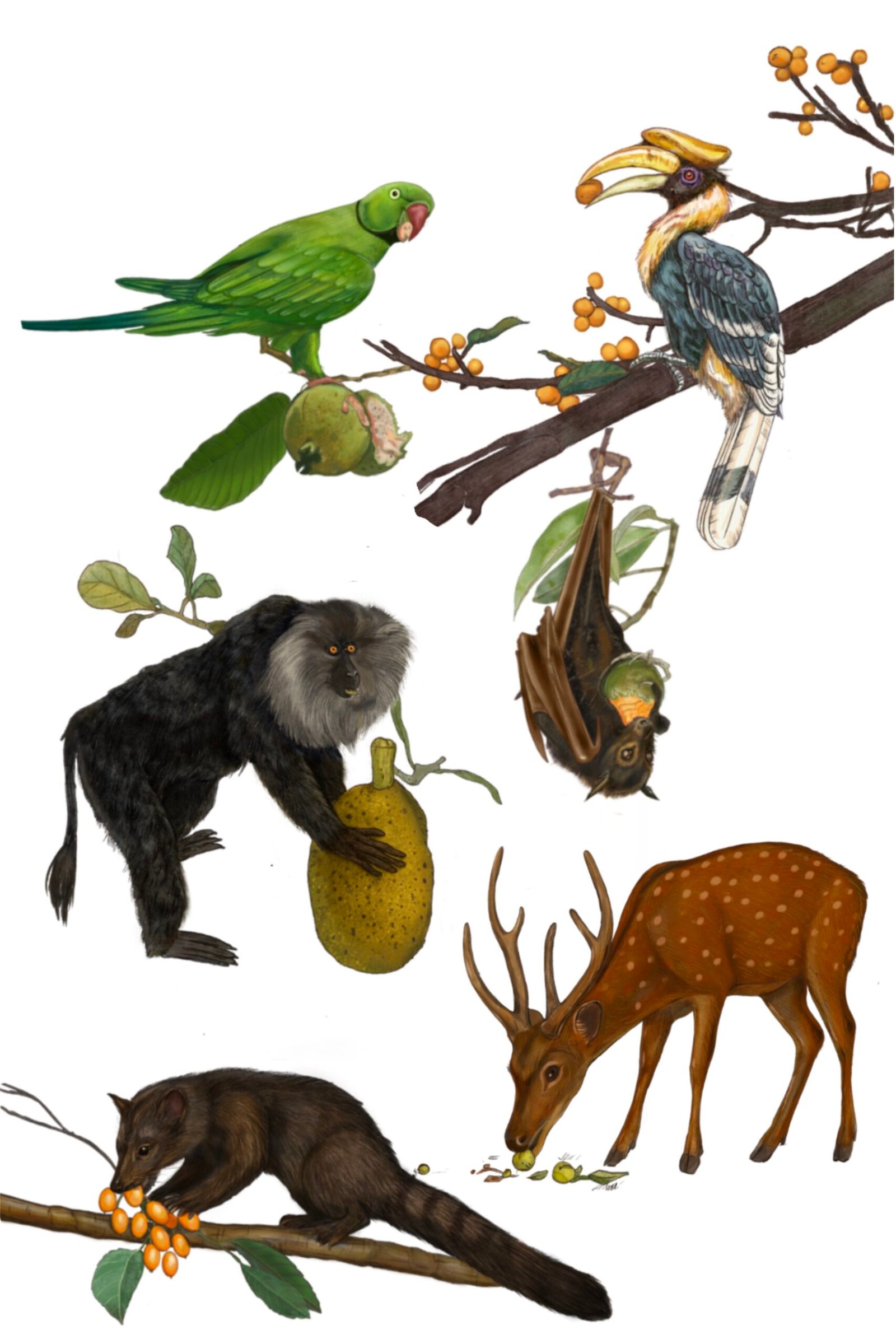
Scientific zoological illustrations for the book “Fruitful Insights”.
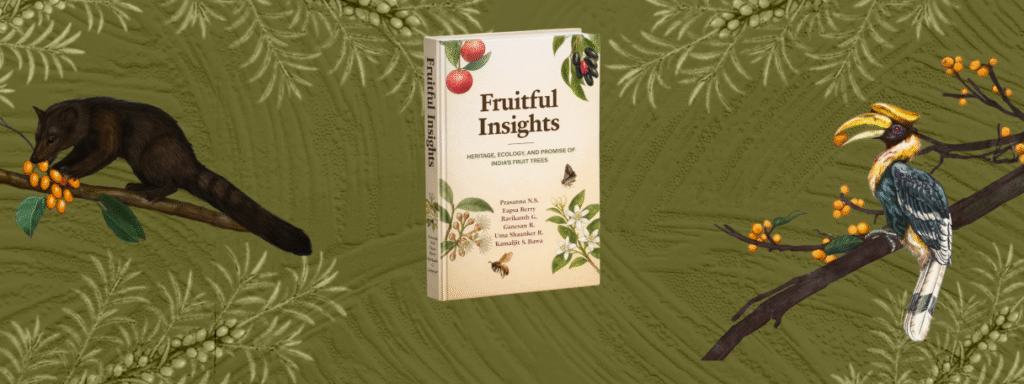
Fruitful Insights explores these intriguing questions and many more, revealing the profound ecological, cultural, and economic significance of India’s fruit trees. From ancient myths such as Shabari offering wild berries to Rama to contemporary stories of the Soliga tribes reclaiming stewardship over Amla forests, the book weaves together history, science, and lived traditions. Richly illustrated and engagingly written, the book examines how fruit trees shape languages, festivals, art, and rural livelihoods. It explains the ecological partnerships between fruiting trees, bees, bats, birds, and even the wind, while also unpacking the chemistry of flavours, pigments, and aromas that attract wildlife and humans alike. Readers are introduced to the science of selective breeding and biotechnology that influences the fruits on our tables today. Bringing together perspectives from ecology, economics, nutrition, and conservation biology, Fruitful Insights reveals fruit trees as a vital link between forests and farms, wildlife and wellness, tradition and technology. Celebrating both iconic fruits like mango and lesser-known wild fruits of India, the book invites scientists, farmers, policymakers, students, and nature lovers to see fruit trees not merely as sources of food, but as living threads that bind India’s landscapes, livelihoods, and legends.
Authors : Prasanna N S Eapsa Berry Ravikanth G Ganesan R Uma Shaanker R Kamaljit S Bawa
The story of fruits and fruiting trees begins deep in evolutionary time. Fleshy fruits evolved as ingenious biological strategies, forming partnerships with animals such as birds, bats, insects, fish, and primates. By offering sweetness, colour, and aroma, fruiting plants persuaded animals to pollinate flowers and disperse seeds, allowing forests to regenerate and spread. Many fruits still carry the signatures of these ancient relationships, including partnerships with species that no longer exist. Even today, wild and domesticated fruit trees play a vital ecological role, sustaining wildlife and supporting human communities.
It is not just forests, fruits even entered our myths, rituals, art, and language as powerful symbols of love, abundance, devotion, and prosperity. Mangoes, bananas, pomegranates, figs, and jamun trees appear in epics, festivals, temple carvings, poetry, songs, and everyday expressions. These cultural traces reveal that fruits did far more than nourish bodies. They shaped values, metaphors, memories, and ways of understanding the natural world. Fruits also travelled with people, quietly reshaping landscapes and diets. India is rich in the diversity of edible fruits and they are deeply connected to global exchange. Rulers and states invested in orchards and experimentation, treating horticulture as a serious pursuit tied to prestige, power, and knowledge. Fruit trees became markers of place, preserving geography and history in their names even as political borders shifted. During the last few centuries, botanical gardens, experimental farms, and public parks became testing grounds where fruit trees from across the world were introduced, studied, and distributed. These spaces reshaped what farmers grew and what people ate, linking plants to systems of governance, science, and economy.
Perennial fruit trees offer hope in a warming world. They support biodiversity, store carbon, stabilise soils, and build ecological and social resilience. By weaving together evolution, ecology, culture, history, and climate, this talk attempts to show that fruit trees are not just sources of sweetness. The talk attempts to invite everyone to see the humble fruit tree not just as food, but as a living thread that binds India’s landscapes, livelihoods, and legends.